
Artificial intelligence is no longer the future; it's the present, influencing many everyday decisions, even if we're not always aware of it. It's behind recommendations, selection processes, personalized services, productivity tools, and systems that are beginning to shape how we work and interact with information.
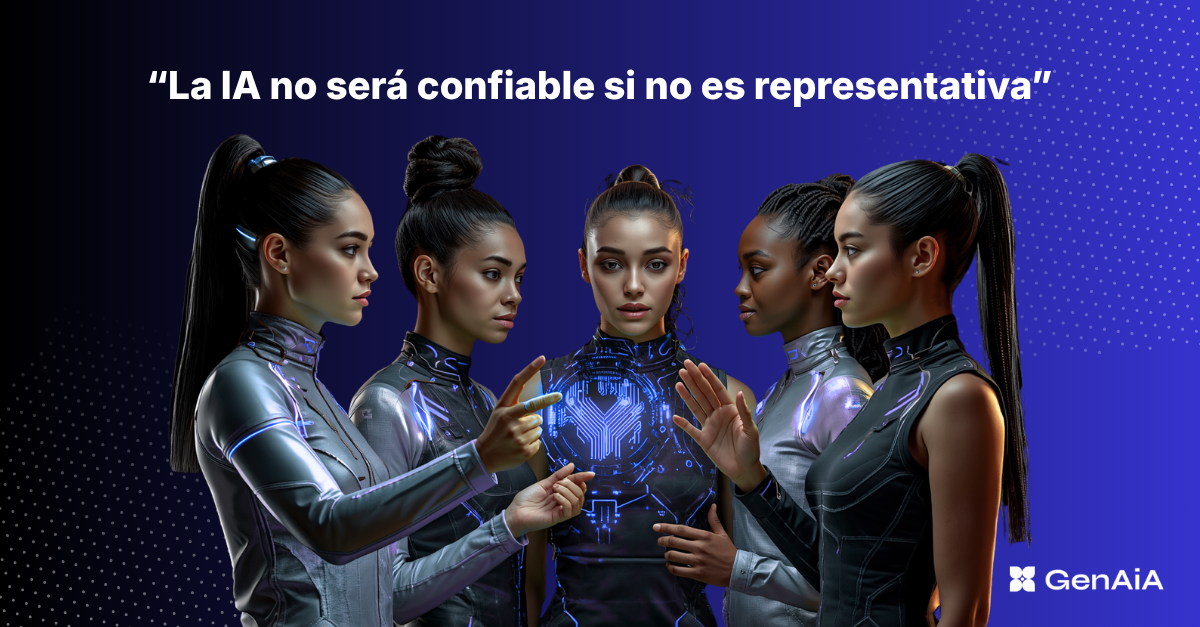
And while its impact grows rapidly, the conversation should focus on who is involved in its design and under what criteria it is being developed. Because behind every model, every piece of data, and every automated decision, there are human decisions. AI learns from historical data, context, and patterns that reflect existing biases and perspectives. And if these decisions don't incorporate diverse viewpoints, we risk building a highly advanced technology that is nonetheless unrepresentative of the society it is meant to serve.
If we want fairer technology, we need to be represented in the conversation. But we also need to be present in the spaces where the technical, ethical, and organizational criteria that guide its development are defined. Diversity doesn't begin when a system is already designed and reviewed for bias; it must be present from the moment we decide what problem we want to solve, what data we'll use to train the model, how we'll measure its impact, and who will be responsible for monitoring it.
The answers to these questions are crucial. We talk about algorithms as if they were objective, but in reality, their design is based on human decisions.
AI is already here, how do we want to live with it?
Artificial intelligence is more a part of our daily lives than we realize. It's present when an algorithm filters candidates in a selection process, when a system decides which content we see first, when we receive personalized recommendations, or when we use tools capable of generating text, images, or code.
We are experiencing a transformation comparable to the one brought about by the internet two decades ago, but with a critical difference: the decisions about how this technology is designed, trained, and deployed are being made now. And that presents us with a unique opportunity to influence the model of digital society we want to build.
The question is no longer whether we will coexist with artificial intelligence. The question is with what criteria, values, and perspectives we decide to develop it. In many conversations about AI that I attend, the focus is on models, capabilities, and productivity, but there is no discussion of the perspectives or criteria under which these AI solutions are being built.
The gender gap in AI: a reality confirmed by data
The numbers don't lie; the data shows that female participation in the technological field remains limited and that this gap widens when the technology we are talking about is Artificial Intelligence.
According to the World Economic Forum's Global Gender Gap Report 2024, women represent only 28.21% of the STEM workforce. In the field of AI, the report AI's Missing Link: The Gender Gap in the Talent Pool (2024), by the European think tank Interface, analyzes more than 1.6 million professionals and concludes that only 22.1% of global AI talent is female, and less than 15.1% holds executive positions.
The gap is not limited to the professional world. Several studies show that women use generative AI tools less than men; this fact can have a double effect: less participation in their design and less familiarity with their use.
This creates a dynamic that is difficult to break: less involvement in design leads to less representative solutions, while less adoption of AI limits future participation. These two realities form a self-reinforcing loop that perpetuates the gap.
Algorithms learn our biases and amplify them.
I've been working with data for years, and if there's one thing I've learned, it's that no human decision based on data is completely neutral. Data reflects reality, but so do the decisions we make about what to measure, which variables to consider, and how to interpret the results. Therefore, algorithms carry the biases with which they were designed.
One of the most well-known cases that came to light in 2018 was that of a large technology company that had developed a solution to optimize its recruitment processes. The model was trained on historical hiring data and began automatically penalizing resumes containing terms associated with female-dominated organizations. The problem wasn't the technology itself, but rather the patterns it had learned from decades of predominantly male decision-making.
AI doesn't invent biases. Algorithms learn these biases from the historical data they are trained on and amplify them at a speed and scope that no human being could achieve alone.
For this reason, diversity in design is not a secondary ethical issue. It is also a matter of quality, innovation, and risk management.
How to build a more inclusive and trustworthy AI
Today we are defining the criteria that companies and institutions must adopt, and which will determine what AI will be developed over the next decade. That is an opportunity, not a threat.
To move towards a more inclusive and reliable Artificial Intelligence, we need concrete actions to be carried out at all levels.
To begin with, it's essential to promote AI literacy so that more women understand how it works and can participate with real knowledge. Companies must provide this training and build diverse, multidisciplinary teams that bring together technical, business, and user experience profiles, thus enriching decision-making and facilitating the early identification of biases.
Second, organizations need to foster diversity as a strategic criterion throughout the entire AI lifecycle, from data selection to model training and governance. This involves not only working with representative data and conducting audits to detect potential biases, but also incorporating systematic fairness reviews, KPIs, and control mechanisms to ensure that systems operate fairly for all groups. It's not just about balancing statistics, but about improving the quality of decisions and reducing operational, reputational, and regulatory risks.
And finally, we are obliged to incorporate from the outset principles of transparency, traceability, human oversight and accountability in any initiative that uses generative AI.
This vision aligns with the European approach to technological development. The European Artificial Intelligence Regulation (AI Act) establishes a framework based on risk management, human oversight, and trust as fundamental pillars for the responsible deployment of AI.
Diversity does not stifle innovation: it reduces risks, improves decision-making, and increases the legitimacy of systems that reach the market. It's about directing it toward objectives that generate real value for people and society.
AI can do things faster, but it remains the responsibility of individuals to decide which principles we want to incorporate into that intelligence. The conversation about artificial intelligence shouldn't be limited to those who develop algorithms or build systems. It's a shared responsibility among businesses, institutions, professionals, and citizens. And the more women participate in that conversation, the more likely we are to build systems that better reflect the diversity of the world they serve.
We have a great challenge ahead of us, but this challenge is not to develop more powerful models; our challenge is to build technology by and for people and ensure that the intelligence we incorporate into our solutions reflects the values of the society they serve.
Gema Ruiz Díaz-Mariblanca
Data & ML CoE Leader Softtek
LinkedIn
World Economic Forum's Global Gender Gap Report 2024: Global Gender Gap Report 2024 | World Economic Forum
AI's Missing Link: The Gender Gap in the Talent Pool (2024), from the European think tank Interface: AI's Missing Link: The Gender Gap in the Talent Pool
Leave a Reply