

Understanding artificial intelligence requires evidence, context, and experience.
AI Research Lab · Information · Articles and analyses.
Our own research, expert experience, and interdisciplinary analysis allow us to separate facts, estimates, and scenarios to interpret what is changing and what decisions it requires.

AI Research Lab
Investigate before concluding
The AI Research Lab focuses our own research and analysis on issues where the evolution of artificial intelligence opens up new decisions for companies, institutions and society.
Reports and publications
Depth for questions that don't allow for quick answers
We develop research, studies, and white papers to address relevant transformations based on evidence, experience, and application.
REPORT · Impact of AI on the employment structure 2026-2030
Articles and analyses
We amplify the analysis of the AI Research Lab and specialists in our ecosystem on issues that are transforming technology, business, and society.
AI Research Lab
Our own research and analysis space. We study issues where the evolution of artificial intelligence opens up new decisions for companies, institutions, and society, combining technical depth with an analysis of its economic, regulatory, organizational, and human implications.

Technology and actual capacity
Models, architectures, data and infrastructures and the conditions that determine their application, evaluation and scalability.

Governance and accountability
How to translate purpose, oversight, safety, and accountability from principles to actual use of AI systems.

Business and Transformation
How AI changes processes, capabilities, organizational structures, and business decisions.

Work and society
How automation transforms employment, professional skills, and the relationship between technology and society.
Reports and publications
Research, studies and white papers that address relevant transformations of artificial intelligence from its technological, economic, organizational and social dimensions.
Document
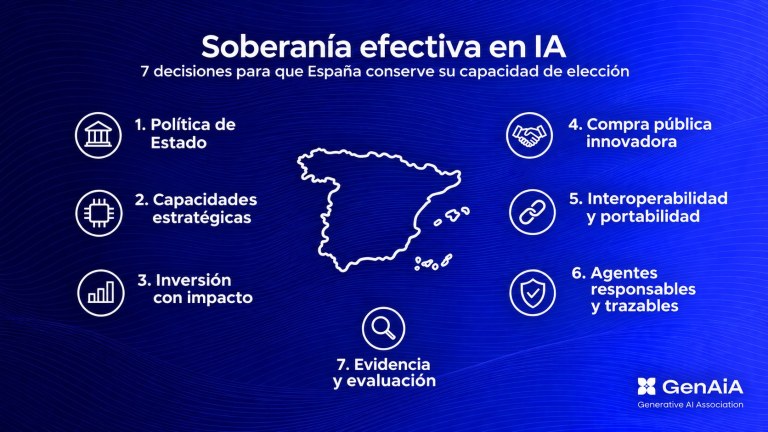
Effective sovereignty in AI: 7 decisions for Spain to retain its capacity to choose
Ahead of the November 29th general election, GenAiA presents seven strategic proposals to strengthen Spain's technological sovereignty. The document outlines the priorities that should be addressed in the next legislature regarding technological capabilities, public investment, business competitiveness, and artificial intelligence governance.

Report
Impact of AI on the employment structure 2026-2030
AI Research Lab | GenAiA · 2026
Analysis of the signals that artificial intelligence is already producing in the labor market and of the scenarios that companies and institutions will have to consider during the transition towards 2030.

Whitepaper
GenAI: Organization and talent
Adopting generative AI requires more than just technology. This white paper addresses how to structure teams, capabilities, and talent to transform new technological possibilities into real-world capabilities within an organization.
Articles and analyses
We amplify the analysis of the AI Research Lab and specialists in our ecosystem on issues that are transforming technology, business, and society.
-

Article
The five mistakes companies make when implementing AI agents
Read more →: Los cinco errores que cometen las empresas al implantar agentes de IAThe success of AI agents depends much less on the model than we usually think and much more on the enterprise architecture: data, security, governance, oversight, and process design.
-

Article
Governing uncertainty: when should AI abstain
Read more →: Gobernar la incertidumbre: cuándo una IA debe abstenerseThere are labyrinths that are not traversed by walking, but by remaining silent. Artificial intelligence has become one of them: a mirror that multiplies possible paths and, at the same time, conceals the point at which the reflection ceases to be legitimate. To govern…
-

Article
AI requires purpose
Read more →: La IA requiere propósitoThat a system functions and meets applicable requirements does not answer the fundamental question: why should AI be involved in a particular decision? The analysis posits purpose, oversight, and accountability as prerequisites for automation.