
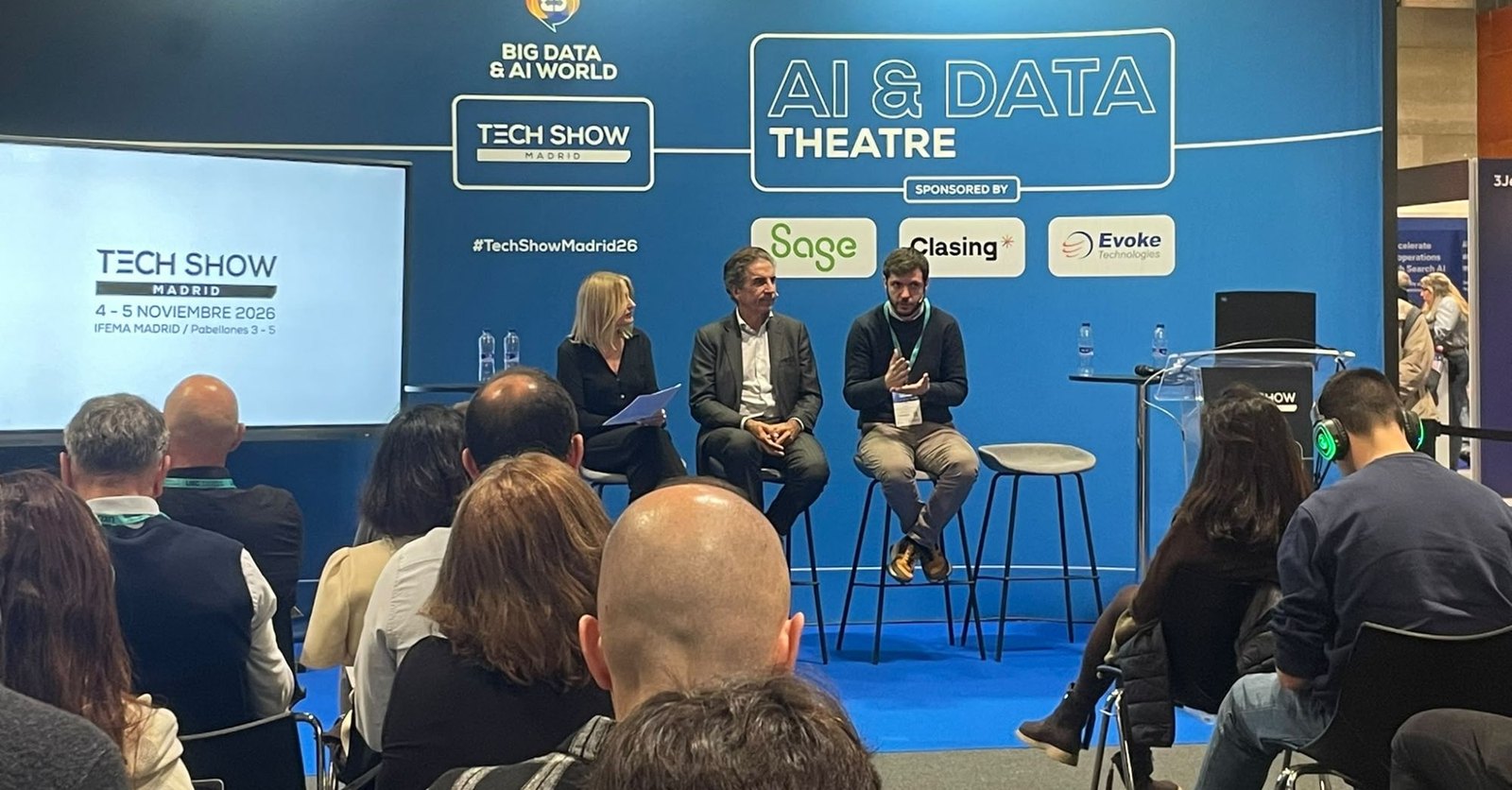
- The association addressed at Tech Show Madrid the need to develop its own AI capabilities and reduce dependence on external technology infrastructures and providers.
- The debate has highlighted the importance of responsible, ethical artificial intelligence adapted to society, which guarantees control over data and autonomy of decision-making.
Madrid, November 5, 2026. – GenAiA (Generative AI Association) participated today in Tech Show Madrid 2026 with the panel discussion “Digital sovereignty and AI: Can Spain build its own capacity or are we outsourcing the future?”, which has addressed the challenges of technological dependence and its implications for Spain's competitiveness, security and economic development.
The meeting raised a central question for the country's digital future, What are the implications of strategic sectors depending on platforms, artificial intelligence models, and technological infrastructures over which they have limited control?
Technological autonomy has ceased to be a purely technical issue and has become a key element for the economy and geopolitics. In this regard, Óscar Méndez Soto has emphasized that “Today, macroeconomics follows macrotechnology”"Warning that, in the next five years, AI processing capacity could become one of the main factors determining the economic weight of countries.".
Faced with a scenario of increasing dependence on external technological solutions, the debate has highlighted the need to identify the strategic infrastructures that Spain must develop and control, promote investment and technological talent, and guarantee greater autonomy in data management. In particular, the importance of developing domestic data centers to reduce critical dependencies and preserve the decision-making capacity of companies and institutions has been emphasized.
But technological sovereignty goes beyond infrastructure and involves deciding how to integrate artificial intelligence into the economy and society. “Sovereignty involves deciding how we are going to implement this technology in our lives.”, Axel Brando pointed out the importance of adapting AI to social and cultural particularities, evaluating its reliability, and reviewing its potential biases before its application.
Responsible artificial intelligence as a development model
The ethical and regulatory dimension has also occupied a central place in the conversation. “Spain needs to develop a responsible, ethical, and socially conscious artificial intelligence.”, Méndez Soto argued, emphasizing that “Regulating does not mean limiting”, Remembering that technological advancement is compatible with responsible governance.
The panel discussion, held with the participation of Óscar Méndez Soto and Axel Brando, and moderated by Natalia Sánchez, president of Omnicom PR Group, has contributed to placing technological sovereignty within a deeper debate on competitiveness, autonomy and responsibility, highlighting the need to articulate a shared vision on the development of artificial intelligence and the model of society we want to build.