

Beyond the Copilot: Their Strategy for the Autonomous Enterprise of 2026
The first wave of generative AI, embodied in the "Copilots," has offered a false sense of disruption in the face of the imminent arrival of the self-employed agents. While these systems have optimized tasks, they operate with a fundamental limitation: they are advanced assistants, not agents with true execution capabilities. Their dependence on constant human supervision is an architectural glass ceiling. They respond to prompts, but they lack the proactive capacity to independently plan and execute complex objectives. The real revolution is not assistance, it's autonomy.
The transition to what we call the Agentica 2.0 Era It radically redefines the role of AI in business. We move from a reactive model to a proactive one, where autonomous agents analyze, plan, learn, and make decisions to achieve strategic goals.
| Feature | He was a Co-pilot (IA 1.0) | Agentic Era (AI 2.0) |
|---|---|---|
| Operating Mode | Reactive (Responds to prompts) | Proactive (Initiates and executes plans) |
| Task Scope | Discrete, single-step tasks | Complex, multi-step processes |
| Human Dependency | Constant (Supervision and direction) | Minimum (Defining objectives and managing exceptions) |
| Decision-making capacity | Limited to predefined options | Autonomous and adaptive |
| Collaboration Model | Human assistant | Contributor to a team of agents |
The 2026 Turning Point: The Three Pillars of Autonomous Agents
Our projection places the year 2026 as the tipping point for the large-scale adoption of enterprise autonomy. This acceleration is not speculative; it is based on the convergence and maturation of three critical technological pillars:
- Multi-step Reasoning and Planning: Unlike current models, the agents of 2026 They will break down high-level objectives (e.g., "optimize the supply chain for Q4") into a sequence of executable and coordinated sub-tasks, adapting to unforeseen events in real time.
- Multi-Agent Systems (MAS): The exponential power lies not in a single agent, but in "fleets" of specialized agents collaborating. Using swarm intelligence and distributed planning, these systems can manage entire organizational processes, from lead generation to after-sales support, eliminating functional silos.
- Contextual Memory and Continuous Learning: The agents will possess long-term memory, learning from each interaction to refine their strategies and personalize their execution. This transforms business processes from static to living systems that continuously improve.
From Increased Efficiency to the Creation of New Value Models
Task automation is the primary benefit, but the real strategic impact lies in end-to-end business process automation. This not only frees up human capital but also completely redefines cost structure and operational agility.
Let's consider the wealth management sector. Data indicates that financial advisors dedicate up to a 67% of their time to low-value administrative tasks: scheduling, meeting summaries, follow-ups and report preparation.
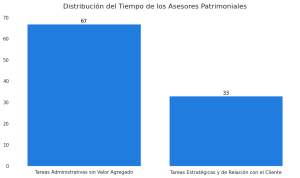
An independent agent can absorb all of these functions, allowing the advisor to focus on 100% Investment strategy and customer relationships are the only activities that truly generate value and loyalty. This model can be extrapolated to virtually any knowledge role.
Strategic Preparation: Roadmap for Adopting Autonomous Agents
Leaders who act now will build a decisive competitive advantage. The preparation is not technological; it is strategic and organizational.
- Audit Processes, not Tasks: Identify complete, multi-departmental workflows with high automation potential. The goal is not to replace tasks, but to redesign processes for autonomous execution.
- Build the Infrastructure of Trust: Autonomous agents need accessible, reliable, and secure data. Data governance is no longer just a compliance function; it's becoming the core enabler of autonomy.
- Redesign Your Talent: The future of human work is not execution, but leadership. Roles will evolve toward strategic oversight, managing complex exceptions, and, most importantly, defining objectives and ethical boundaries for agent fleets.
Challenges on the Horizon: Navigating Complexity
The path to full autonomy is not without its obstacles. Technical feasibility has been demonstrated in controlled environments, but robustness, security, and governance at enterprise scale are the real challenges to overcome.
- Systemic Complexity: In multi-agent systems, managing conflicting objectives and ensuring latency-free communication is a highly complex engineering challenge.
- The Trust Gap: Adoption depends on reliability and transparency. Leaders must demand systems whose decisions are auditable and understandable to their human supervisors.
- Governance and Ethics: Deploying autonomous actors with decision-making power raises profound ethical questions. Establishing robust governance frameworks before large-scale deployment is imperative.
In conclusion, the Agentic Era 2.0 It represents a more profound paradigm shift than simply introducing generative AI. It's the transition from tools that help us work to systems that work for us. Organizations that begin developing their strategic piloting capabilities around these technologies today will not only lead the market in 2026, but they will define it.
Sources and References
- AI Agents: From Copilot to Autopilot
- From co-pilots to agents: the future of work with AI – Tomás…
- Projected future: The evolution of AI and its impact on the real estate sector
- The Agentic Era of AI: Intelligent and Autonomous Assistants
- AI Agent-Centric: Autonomous agents as the new business copilots
- Autonomous agents: AI that no longer just responds, but acts
- Autonomous agents as the spearhead – Cuatroochenta
- Agentic AI: The new generation of autonomous agents
- What are autonomous agents? A complete guide
- Agentic AI: A new engine for transforming business processes
- AI Agents: The Second AI Revolution in Business
- AI agents: 'the next big thing' in business transformation
- AI in Multi-Agent Systems: How they interact and collaborate
- Article Zero: The Rebirth of AI Agents
- The evolution of artificial intelligence and its speed – Enrique Dans
Leave a Reply