
The Payment Methods Industry It is experiencing a slowdown in mature markets, where the global industry is expected to slow down. will reach 2.3 trillion/$ by 2028, with an annual growth rate of 5%. This This figure is lower than the growth of 9% recorded in the last 5 years, when the market reached 1.8 trillion/$ in 2023.
According to experts, North America and Europe will experience the greatest slowdowns, with annual growth of 3.1% (3TQ). Asia-Pacific will see annual growth of 6.1% (3TQ), driven by digital payments and the rise of middle-class consumers, while Latin America and the Middle East and Africa will experience annual growth of 9.1% (3TQ) and 7.1% (3TQ) respectively, driven by the acceleration of digital payments in emerging markets.
To avoid this slowdown, Payment companies are using generative artificial intelligence (GenAI) in its first and second line processes. The implementation of GenAI will limit traditional payment companies due to the doubts surrounding the application of this technology.
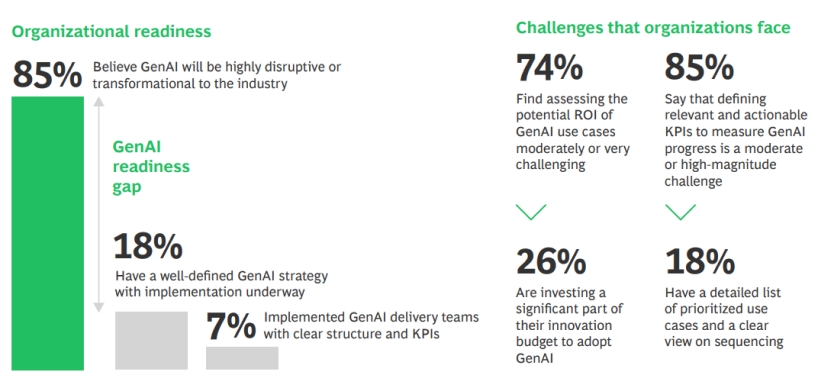
- Hoping the business case is more certain. 85% of companies expect GenAI to be transformative, but 74% say they find it difficult to assess its profitability.
- Concern about exposure to investment. Only 261% of financial services companies allocate their innovation budget to GenAI. They believe that long-term benefits are difficult and complex, and they are concerned about sacrificing short-term growth.
- Doubts whether the current tools and resources are adequate. Most companies recognize that they need to improve their data and IT readiness. Only 181% of companies have a well-defined GenAI strategy, and only 71% have implemented teams with a clear operational structure and key performance indicators.
Payment companies face to a gap in preparation for GenAI, The 85% believes that technology is transformative, but Only the 18% has a defined strategy and an initiated implementation.
Only a few leading payments companies are making progress and generating short-term benefits through the implementation of GenAI:
- Klarna, uses GenAI to manage customer service chats (equivalent to 700 employees), with an improvement in its results of 40 million/$ in 2024. Since its implementation, the average resolution time has been reduced from 11 to 2 minutes.
- MasterCard and Visa, GenAI uses to detect fraudulent behavior, improving its fraud prevention capabilities.
- Additionally, there are use cases in four specific operational areas:
- Improvement of customer service and operations. Automated assistance can promote faster and more effective problem resolution, reducing the cost of service by up to 70%.
- Improved sales and marketing. GenAI can enable companies to hyper-personalize and individualize messaging, potentially increasing sales through customer interactions and acting as a sales coach.
- Greater efficiency in compliance. GenAI can serve as a real-time assistant to get to know your customers and help risk and compliance teams create the necessary documentation.
- Assisted coding. GenAI can help code, prototype, test, and document software. Examples include chat portal interfaces for consumers and merchants, risk and compliance applications such as transaction monitoring tools, and payment flow reconciliation support tools.
Given the above, banks will need to reinvent payments and their business approach. Current models are not competitively sustainable, and they cannot continue to lose market share.
Let's not forget that cash and payment management are key products that generate customer engagement, cross-selling opportunities, and highlight the importance of transaction data. According to the FinTech Control Tower report, There are more than 6,500 FinTech companies focused on payments, which have attracted more than £125 billion in equity funding. For example, companies Stripe and Adyen They rival the largest banks in transaction volume, in areas where banks have invested little or withdrawn, such as acquisitions and cross-border payments.
In conclusion, The use of GenAI in the payments market is changing the way consumers interact and transact online, and transforming companies to improve operational processes linked to these needs and, additionally, to personalize customer interactions in payments, obtaining 40% more revenue and savings of 15% in operating costs with the implementation of GenAI.
Author: Verónica Sánchez Medero, Global Capital Markets Leader